 contact@nxhdmfg.com
 +86 352 5330772
 +86 180 3528 0246

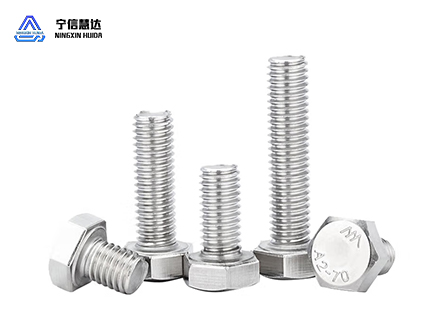
If you have ever ordered metric bolts from a supplier, you have seen markings like 8.8, 10.9, or 12.9 stamped on the bolt head. These numbers are not random — they follow the international standard ISO 898-1 and tell you exactly how strong the bolt is. Understanding what they mean is essential for procurement teams, design engineers, and quality inspectors who need to specify or verify the right fastener for a given application.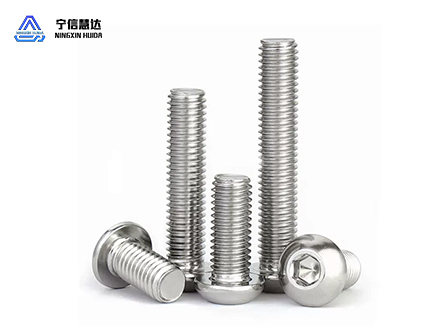
Here are the metric bolt strength grades you will encounter most often in industrial procurement, along with typical applications.
| Grade | Tensile (MPa) | Yield (MPa) | Typical use |
|---|---|---|---|
| 4.6 | 400 | 240 | Low-stress applications, brackets, non-critical joints |
| 8.8 | 800 | 640 | General mechanical engineering, automotive, machinery |
| 10.9 | 1000 | 900 | High-stress structural joints, automotive powertrain, hydraulic |
| 12.9 | 1200 | 1100 | Very high stress, suspension, engine internals, racing |
| 14.9 | 1400 | 1260 | Special applications, often custom |
Grade 8.8 is the workhorse of the fastener world — it handles the majority of medium-duty applications. Grade 10.9 is the next step up and is widely used where higher preload and tighter clamping force are needed. Grade 12.9 is reserved for the most demanding applications and requires careful attention to torque specification, joint stiffness, and thread engagement length, because it is closer to its failure point under repeated loads.
How to choose the right grade
Choosing a bolt grade is not about picking the strongest option. Over-specifying wastes money and can make assembly harder. Under-specifying risks failure. The right approach is to match the grade to the load, the environment, and the design life.
A few practical rules of thumb:
- Calculate the required clamp force from your joint stiffness and the load on the joint. Then select a grade whose yield strength comfortably exceeds that clamp force with a safety factor of 1.2 to 1.5 or higher.
- Check thread engagement length. Higher-grade bolts transfer higher preload, so the receiving thread (in a nut or tapped hole) must be deep enough to handle the load without stripping.
- Consider the environment. In corrosive or high-temperature service, the bolt's mechanical strength must still be adequate after accounting for corrosion allowance or temperature derating.
- Match the nut grade. A grade 10.9 bolt paired with a grade 8 nut is a weak joint. Always use a nut rated at least as high as the bolt.
For OEM buyers sourcing fasteners for a new product, the cheapest path is usually to ask your bolt supplier to recommend a grade based on your torque spec and joint design — that conversation will save you both cost and warranty risk. If you are fastening into thin sheet metal rather than into a tapped hole or nut, the rules change — see our companion guide on choosing the right self-tapping screw tip geometry for light-gauge steel.
Common mistakes to avoid
A few pitfalls we see repeatedly in incoming inspection and field failures:
- Mixing grades by accident. A box of grade 10.9 bolts mixed with grade 8.8 will silently underperform in the parts of your assembly that were designed for 10.9. Always verify markings on first articles and on lots from new suppliers.
- Assuming higher grade means better quality. Grade 12.9 bolts are not "better" than 8.8 bolts in any absolute sense. They are harder, more brittle, and more sensitive to hydrogen embrittlement during plating.
- Ignoring the property class on the packaging. Suppliers sometimes default to a common grade. The carton label and the bolt head markings should agree.
- Replacing a higher grade with a lower grade during cost reduction. A bolt that was specced as 10.9 cannot be quietly substituted with 8.8 without a re-validation of the joint.
Key takeaways
- The metric bolt strength grade is two numbers: tensile strength (×100 MPa) and yield strength ratio (×10).
- 8.8, 10.9, and 12.9 are the three grades you will most often specify.
- Choose the grade based on clamp force, joint design, environment, and matching nut — not just "strongest is best."
- Always verify markings on incoming lots, especially when changing suppliers.
NXHD Manufacturing (contact@nxhdmfg.com) is a precision fastener and custom metal parts manufacturer with dual production bases in Handan and Datong, China. We supply standard and non-standard fasteners — including grade 8.8, 10.9 and 12.9 bolts to ISO 898-1 — to OEM customers across Europe, the Americas and Asia. Send us your drawings or torque specification and our engineers will recommend the right grade for your application. Every grade we ship is backed by the in-house tensile, torque and hardness testing documented in our ISO 9001 / 14001 / 45001 recertification, and our team will be on the floor at the Handan (Yongnian) Fastener Exhibition 2026 this September to walk through grades in person.