 contact@nxhdmfg.com
 +86 352 5330772
 +86 180 3528 0246

Turnbuckles are one of the most widely used tensioning devices in rigging, marine, construction, and industrial machinery. They look simple — a metal frame with two threaded end fittings — but specifying the wrong body size, end style, or load rating can lead to joint slack, premature wear, or even failure under load. This guide explains how turnbuckles work, how to read their specifications, and what procurement teams should check before placing an order.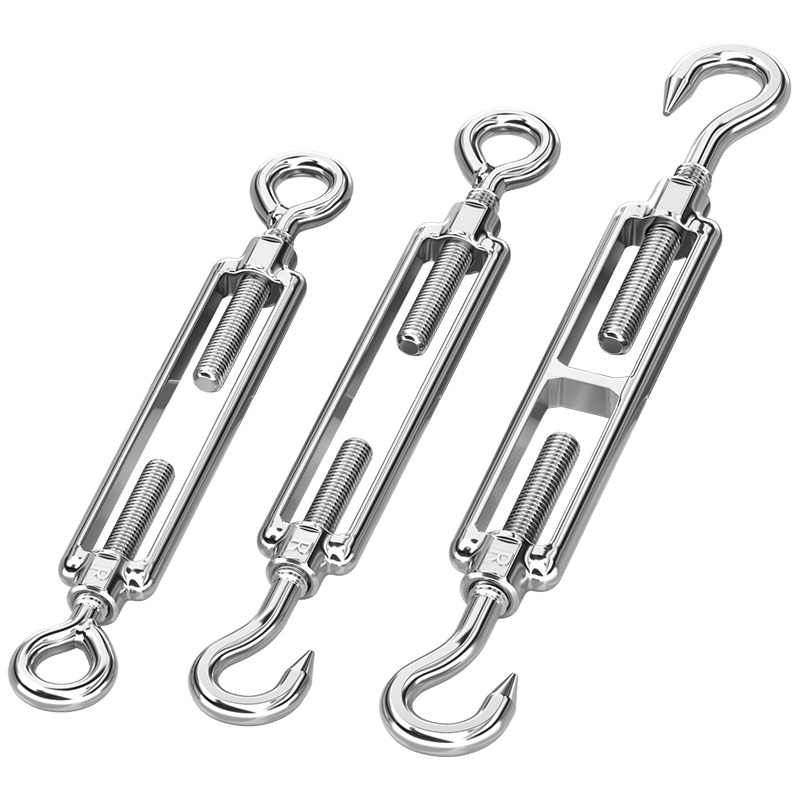
What a turnbuckle does and how it works
A turnbuckle is a mechanical device used to adjust the tension or length of a cable, rod, chain, or rope. It consists of a central body — usually an open frame or closed pipe — with internal left-hand and right-hand threads. One end fitting screws in from the left, the other from the right. Rotating the body clockwise or counter-clockwise either draws both ends inward to tighten the assembly or pushes them outward to loosen it, all without disconnecting the rigging.
This bidirectional adjustment makes turnbuckles far more convenient than fixed-length shackles or eyebolts when the line needs periodic re-tensioning. Common applications include guy wires, sailboat rigging, theatre rigging, shade structures, bridge cable bracing, and conveyor belt tensioning.
Most turnbuckle bodies are drop-forged or cast from carbon steel, stainless steel, or malleable iron. The forging or casting method affects both cost and strength. Forged bodies are generally stronger and more fatigue-resistant, while cast bodies are economical for light-duty, static loads. At NXHD, lean casting components are often used for lower-load fittings where surface finish and dimensional consistency matter more than ultimate tensile strength.
End fittings: eye, hook, jaw, and stub
The first specification decision is the end-fitting combination. Turnbuckles are sold with matching or mixed ends. The four most common styles are:
- Eye and eye: Both ends are closed loops. Best for permanent or semi-permanent connections where the line terminates in a shackle or thimble. No risk of accidental release, but the assembly must be disconnected to remove the turnbuckle.
- Hook and eye / hook and hook: One or both ends are hooks. Fast to install and remove, but hooks can unseat if tension is lost or if the line moves laterally. Use only where the load is steady and the hook is positively loaded.
- Jaw and jaw: Both ends have a flat clevis with a pin. Ideal for connecting to structural plates, brackets, or welded lugs. The pin must be secured with a cotter pin or split pin to prevent rotation-induced loosening.metric vs inch thread standards to keep the specification consistent across the assembly.
Material, finish, and load rating
Turnbuckle performance depends on material grade, protective finish, and the stated working load limit (WLL).
Carbon steel turnbuckles are the most common and economical. They are usually zinc-plated or hot-dip galvanized for corrosion protection. Stainless steel — typically 304 or 316 — is preferred for marine, food-processing, or outdoor architectural applications where rust staining is unacceptable. 316 stainless steel adds molybdenum and performs better than 304 in chloride-rich environments such as coastal or offshore locations.
Finish selection follows the same logic as any exposed fastener. Zinc plating is thin and suited to dry indoor environments. Hot-dip galvanizing gives a thicker, duller coating that protects structural hardware for decades outdoors. For a broader comparison of protective coatings, see our article on fastener surface coatings: zinc vs hot-dip galvanizing vs Dacromet.
The working load limit is the maximum load the manufacturer recommends in service. It is not the same as the breaking load, which is typically several times higher. Reputable suppliers mark the WLL or the body size on the frame. When in doubt, size the turnbuckle so that the expected working load is no more than 25 percent of the breaking load — in other words, use a safety factor of at least 4:1 for lifting or personnel applications, and never less than the value required by local regulation.
Installation and safety considerations
A correctly installed turnbuckle should have enough exposed thread on both ends to remain engaged after adjustment. A common rule of thumb is that at least one full thread diameter should remain inside the body at the minimum setting, though specific standards may require more. Over-tightening can damage the threads or deform the body; under-tightening leaves the line loose and the fitting prone to shock loading.
Locking the turnbuckle after adjustment is essential in vibrating environments. Common methods include:
- Lock nuts or jam nuts on the end fittings.
- Cotter pins or safety wire through the end fitting and body.
- Special-shaped parts such as locking pins or castellated nuts, when specified by the designer.
Regular inspection is also important. Check for bent frames, cracked end fittings, distorted threads, and corrosion that has reduced the cross-section. A single turnbuckle with visible deformation should be replaced immediately; straightening it is not safe. For an inspection checklist that applies to rigging hardware as well as standard fasteners, refer to our guide on how to inspect incoming fasteners.
When a project calls for non-standard lengths, oversized eyes, or mixed thread forms, buyers should treat the order as a custom part rather than an off-the-shelf rigging item. Clear drawings showing body length, thread size, end-fitting dimensions, material grade, finish, and required WLL will help the supplier quote accurately and avoid rework.
Conclusion
Turnbuckles are small components with an outsize role in tensioned assemblies. Choosing the right end fitting, material, finish, and load rating keeps the assembly safe, adjustable, and durable. Before placing a purchase order, confirm the thread form, the safety factor required by your application, and whether the hardware needs third-party certification.
NXHD Manufacturing (contact@nxhdmfg.com) is a precision fastener and custom metal parts manufacturer with dual production bases in Handan and Datong, China. We supply standard and non-standard fasteners to OEM customers across Europe, the Americas and Asia.
Key takeaways
- Turnbuckles adjust tension by rotating a body with opposite-hand internal threads.
- Eye, hook, jaw, and stub end fittings suit different connection and safety needs.
- Match the material and finish to the environment: carbon steel with zinc or hot-dip galvanizing for general use, 316 stainless steel for marine or corrosive settings.
- Size the turnbuckle to a safe working load limit, applying the required safety factor for lifting or structural applications.
- Leave enough engaged thread after adjustment and lock the fitting to prevent loosening under vibration.
Frequently asked questions
What is a turnbuckle used for?
A turnbuckle is used to adjust the tension of a cable, rope, rod, or chain in rigging and structural assemblies. By rotating the body, installers can tighten or loosen the line without disconnecting the ends.
Which turnbuckle end fitting should I choose?
Choose eye ends for permanent shackled connections, hook ends for quick temporary rigging, jaw ends for clevis-pin connections to plates or brackets, and stub ends for welded or embedded mounts. Hooks should be avoided where the load can reverse or shift sideways.
What does working load limit mean on a turnbuckle?
The working load limit (WLL) is the maximum load the manufacturer recommends during normal service. It is lower than the ultimate breaking load, and lifting or personnel applications usually require a safety factor of at least 4:1.
Should I choose stainless steel or galvanized steel turnbuckles?
Choose 316 stainless steel for marine, coastal, or chemical environments where chloride corrosion is a concern. Choose galvanized carbon steel for structural outdoor applications where cost matters and a dull, thick coating is acceptable.
What standards cover turnbuckles and rigging hardware?
Turnbuckles are commonly covered by standards such as DIN 1480, DIN 1489, US Federal Specification FF-T-791, and ASME B30.26 for rigging hardware. Marine and lifting applications may also require classification-society or OSHA approval.
Can NXHD supply custom turnbuckles and rigging hardware?
Yes. NXHD Manufacturing supplies standard fasteners and custom metal parts, including special-shaped rigging fittings and machined or cast turnbuckle components, from its production bases in Handan and Datong, China.