 contact@nxhdmfg.com
 +86 352 5330772
 +86 180 3528 0246

When sourcing fasteners across borders, few problems are as common — or as avoidable — as thread mismatch. A bolt that looks right, measures right and even starts threading can still be the wrong thread system, and the joint will fail in service or the part will come back as a return. For procurement engineers and mechanical designers who order from international suppliers, being able to read and specify thread callouts correctly is one of the highest-value skills on the drawing. This article explains how ISO metric and Unified inch thread designations work, how coarse and fine pitch differ, and what to write on a purchase order so the parts you receive mate with the parts you already have.
Why thread systems still cause trouble
Two thread systems dominate worldwide supply. ISO metric threads, defined in standards such as ISO 68-1 and ISO 261 (and their DIN and GB equivalents), specify size by nominal diameter in millimetres and pitch in millimetres. Unified inch threads, defined in ASME B1.1, specify size by nominal diameter in inches and by threads per inch (TPI). Both systems use a broadly similar 60-degree thread profile, which is exactly why they are so deceptive: an M10 bolt will thread a turn or two into a 3/8"-16 tapped hole. It will feel almost right, then bind, and if it is forced in with a wrench, the joint may hold initially — with a fraction of the intended strength.
In practice, mismatches happen most often when drawings are converted between systems, when a customer inherits an older US-designed machine, or when standard hardware is assumed to be universal. At the same nominal size there is no safe cross-use between metric and inch threads: a joint either has a fully specified, matched thread, or it has a latent defect.
How metric thread callouts work
A metric callout has the form M10 × 1.5. The "M" identifies the ISO metric thread, "10" is the nominal diameter in millimetres, and "1.5" is the pitch — the distance between adjacent thread crests, in millimetres. If the pitch is omitted, the coarse pitch is implied: an "M10 bolt" means M10 × 1.5, an "M8" means 8 × 1.25, an "M6" means 6 × 1.0, and an "M12" means 12 × 1.75.
Metric threads also come in fine and extra-fine pitches. M10 × 1.25 and M10 × 1.0 are the common fine variants for a 10 mm bolt; M12 × 1.25 and M12 × 1.5 serve the same role above it. Fine pitches are widely used on thin-walled components, adjustment mechanisms and parts subject to vibration, for reasons covered below.
A complete thread specification also includes a tolerance class. The most common pair for general engineering is 6g on the external thread and 6H on the internal thread; tighter classes such as 5g6g or 4H5H are used where a precise, low-play fit is needed. Two suppliers can both deliver "M10" bolts with different effective fits if the tolerance class is not stated.
How inch thread callouts work
An inch callout has the form 1/4"-20 UNC or 1/4"-28 UNF. The first number is the nominal diameter in inches, the second is the number of threads per inch, and the suffix names the series: UNC for the coarse series, UNF for the fine series. So 1/4"-20 and 1/4"-28 share a diameter but have completely different threads — 20 threads per inch versus 28 — and do not interchange. Other common pairs are 3/8"-16 UNC / 3/8"-24 UNF and 1/2"-13 UNC / 1/2"-20 UNF.
Buyers working with legacy equipment may also meet older British series (BSW and BSF), which use a 55-degree profile and are compatible with neither UNC/UNF nor metric threads, plus tapered pipe threads such as NPT, which seal by interference of the taper and are a separate subject from machine threads. When a drawing says only "1/4 thread", it is worth clarifying in writing which series is intended.
Coarse versus fine pitch: choosing deliberately
Most standard fasteners — hex bolts, studs, nuts and the majority of self-tapping screws — are supplied in coarse pitch by default, and for good reason. Coarse threads assemble faster, tolerate dirt and handling damage better, are less prone to cross-threading during manual assembly, and their slightly deeper engagement suits most structural joints.reading bolt strength grade markings.
A specification checklist for buyers
Most thread problems are eliminated before production by writing complete callouts. A practical checklist:
- State the pitch or TPI explicitly, even for coarse threads. "M10 × 1.5" and "1/4"-20 UNC" leave no room for interpretation.
- Name the standard. ISO 261 / ISO 965 for metric, ASME B1.1 for unified inch. DIN 13 and GB/T 196 are the common metric equivalents; where a drawing cites DIN, confirm whether it predates the ISO-aligned revision.
- Include the tolerance class (typically 6g/6H) on both the bolt and the tapped hole, especially for machined or cast parts where the thread is cut in-house.
- Specify thread runout and chamfer on custom parts — an incomplete last thread can make a nut appear to bind even when the thread itself is correct.
- Verify with gauges at incoming inspection. A GO/NO-GO thread gauge set for each callout catches mixed batches cheaply; our guide to incoming fastener inspection covers how to build this into a sampling plan.
- Watch thread-forming parts separately. Self-tapping and thread-rolling screws form their own mating thread, so the tapped-hole spec is different from machine-thread assembly; this is covered in our self-tapping screws guide for light gauge steel.
Where a project needs a thread size that sits outside catalogue ranges — an extra-fine pitch on a large diameter, or a legacy BSW thread on replacement equipment — it is usually more economical to order the part as a custom item than to attempt a conversion. The decision framework is set out in our article on standard versus non-standard fasteners.
Conclusion
Thread specification looks like a small detail on the drawing, but it determines whether suppliers in different countries can deliver parts that assemble the first time. Metric and inch threads are not interchangeable, coarse and fine pitch are not interchangeable, and "M10" without a pitch and tolerance class is only half a specification. Writing the full callout — system, diameter, pitch, series, standard and tolerance class — costs minutes on a purchase order and prevents the most common cause of reworked custom parts. NXHD Manufacturing (contact@nxhdmfg.com) is a precision fastener and custom metal parts manufacturer with dual production bases in Handan and Datong, China. We supply standard and non-standard fasteners to OEM customers across Europe, the Americas and Asia.
Key takeaways
- ISO metric and Unified inch threads share a similar 60-degree profile but are not interchangeable; an M10 bolt will not properly fit a 3/8"-16 hole, even though it may start threading.
- A complete metric callout is "M pitch", e.g. M10 × 1.5, plus a tolerance class (commonly 6g external / 6H internal); an omitted pitch means the coarse series.
- Inch callouts name the diameter, threads per inch and series — 1/4"-20 UNC (coarse) versus 1/4"-28 UNF (fine) — and must never be mixed with British legacy or NPT pipe threads.
- Coarse pitch suits fast assembly and dirty or manually handled joints; fine pitch gives higher tensile capacity, better vibration behaviour and finer adjustment in thin-walled parts.
- Specify pitch, standard and tolerance class explicitly on every purchase order, and verify with GO/NO-GO thread gauges at incoming inspection.
Frequently asked questions
What is the difference between metric and inch threads?
Metric threads are specified by nominal diameter in millimetres and pitch in millimetres (ISO 261), while Unified inch threads are specified by diameter in inches and threads per inch (ASME B1.1). Their 60-degree profiles look alike, but the dimensions never coincide, so a metric bolt cannot properly mate with an inch tapped hole.
Can I use an M10 bolt in a 3/8"-16 threaded hole?
No. An M10 bolt (10 mm diameter, 1.5 mm pitch) will thread one or two turns into a 3/8"-16 hole and then bind, and forcing it damages both threads. Even if it can be driven in with force, the joint has only a fraction of the intended strength and is a latent defect.
How do I read a metric thread callout like M10 × 1.5?
The M identifies an ISO metric thread, 10 is the nominal diameter in millimetres, and 1.5 is the pitch — the distance between thread crests in millimetres. If no pitch is written, the coarse pitch is implied, which for M10 is 1.5 mm.
When should I choose fine pitch instead of coarse?
Choose fine pitch when you need higher tensile capacity in the same diameter, better resistance to loosening under vibration, more load-bearing turns in a thin wall or short engagement, or finer adjustment. Stick with coarse pitch for faster assembly, tolerance of dirt and handling damage, and general structural joints.
Which standards define screw threads for fasteners?
ISO metric threads are defined in ISO 68-1 (profile), ISO 261 (general plan) and ISO 965 (tolerances), with DIN 13 and GB/T 196 as widely used national equivalents. Unified inch threads are defined in ASME B1.1, and tapered pipe threads in ASME B1.20.1 (NPT).
Does NXHD Manufacturing supply both metric and inch threads?
Yes. NXHD Manufacturing produces standard fasteners in ISO metric and Unified inch series, as well as non-standard threads on custom studs, special-shaped parts and machined components, to OEM customers in Europe, the Americas and Asia. Thread callouts, tolerance class and gauge verification can be confirmed on first articles before volume production.
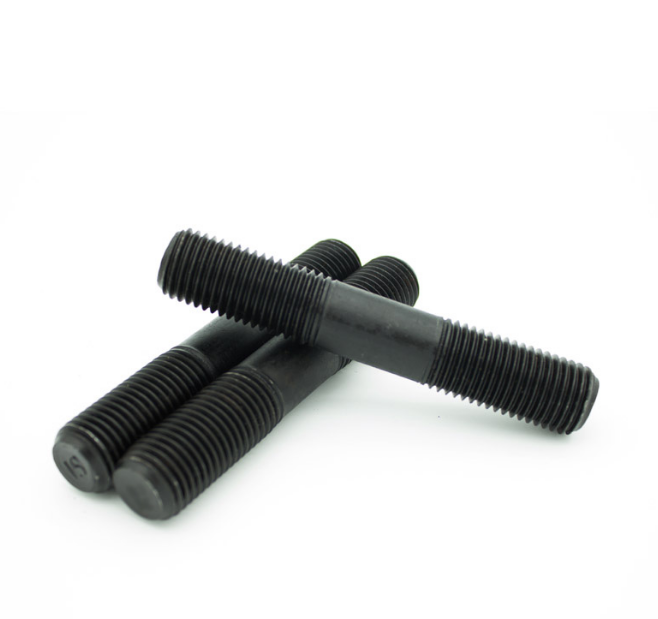
Cover photo: NXHD high-strength threaded studs. Article prepared by the NXHD editorial team.