 contact@nxhdmfg.com
 +86 352 5330772
 +86 180 3528 0246

Bolts and nuts work well when both parts of the joint are thick enough to carry a full thread. In sheet-metal enclosures, tubes and extrusions, that is rarely the case: a 2 mm sheet gives a bolt only two or three turns of engagement, which strips out under any real clamp load. The usual answer is a captive nut — a threaded element that is fixed to the thin part first, so the bolt has a full-length, machine-cut internal thread to pull against. The three main families are weld nuts, cage nuts and rivet nuts, and they differ mainly in how they are attached and whether they can be removed later. This article compares all three so that designers and procurement teams can specify the right one.
Why standard nuts struggle in thin sheet
The starting point is thread engagement. A common engineering rule of thumb is that a bolt in steel needs roughly one diameter of engaged thread to develop its full clamp load; in aluminium and other softer materials, more is required. A sheet of 1 to 3 mm simply cannot provide that, and tapping the sheet directly yields a short, fragile thread that wears out after a few assembly cycles.
Designers therefore face a choice. Self-tapping and self-drilling screws form or cut their own thread in the sheet and are fine for light, non-critical joints — we covered where they fit, and where blind rivets fit instead, in an earlier article on sheet-metal fastening options. But when the joint needs a machine thread — because the hardware will be opened and closed repeatedly, because a precise screw grade is required, or because the fastener must be undone from one side only — a captive nut is the better route.
Captive nuts also let one standard bolt size serve an entire assembly, which simplifies spare-parts management.
Weld nuts: the permanent, high-strength option
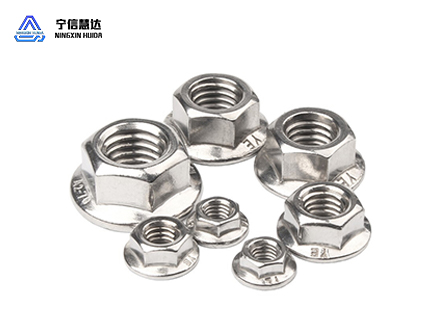
Weld nuts are hex or square nuts with projections — small raised pads on the bearing face — that are spot- or projection-welded into a hole or onto the surface of the sheet. In metric practice the classic designs are the four-projection welded nut covered by DIN 928 and the six-point flange welded nut covered by DIN 929. Because the nut becomes part of the structure itself, a welded joint is typically the strongest captive-nut arrangement available: it resists high clamp loads, torque and vibration without relying on the sheet for retention.
The trade-offs are all on the process side. The nut must be welded in during fabrication, before painting or coating, which means the assembly sequence has to be planned: weld, clean, then finish. Welding on very thin sheet can cause distortion, and coated or galvanized parent material needs attention because zinc boils off during welding. Fixturing and weld parameters matter for positional accuracy — the nut must end up square to the sheet or the bolt will bind. Once welded, the nut is there for good; a mistake means grinding and rework.
Weld nuts make the most sense at higher volumes, where a welding cell is already part of the line and the design is stable. For enclosures made in the thousands, they are usually the cheapest captive thread per unit.
Cage nuts: the serviceable option for panels and racks
A cage nut is a standard square nut held in a spring-steel cage. The sheet gets a square hole — the format popularized by 19-inch server racks and telecom frames in IEC 60297-class equipment — and the cage snaps into it. The nut floats inside the cage, so it self-aligns to the bolt, and the whole assembly can be pried out and relocated with an inexpensive cage-nut tool.
That removability is the whole point. Cage nuts suit equipment that is configured, reconfigured and serviced throughout its life: rack-mounted electronics, modular enclosures, panels where hole positions may change between variants. The floating nut also tolerates slight misalignment and dampens vibration transfer through the spring contacts.
The limitations are load and cost. The nut is retained only by the spring cage and the edges of the square hole, so clamp loads are moderate — cage nuts are not the answer for structural joints. Unit cost is the highest of the three families, since each installation is nut plus cage, and the square cutout needs reasonable edge distance in the panel. For service-intensive assemblies that premium is worth paying.
Rivet nuts: one-sided installation anywhere
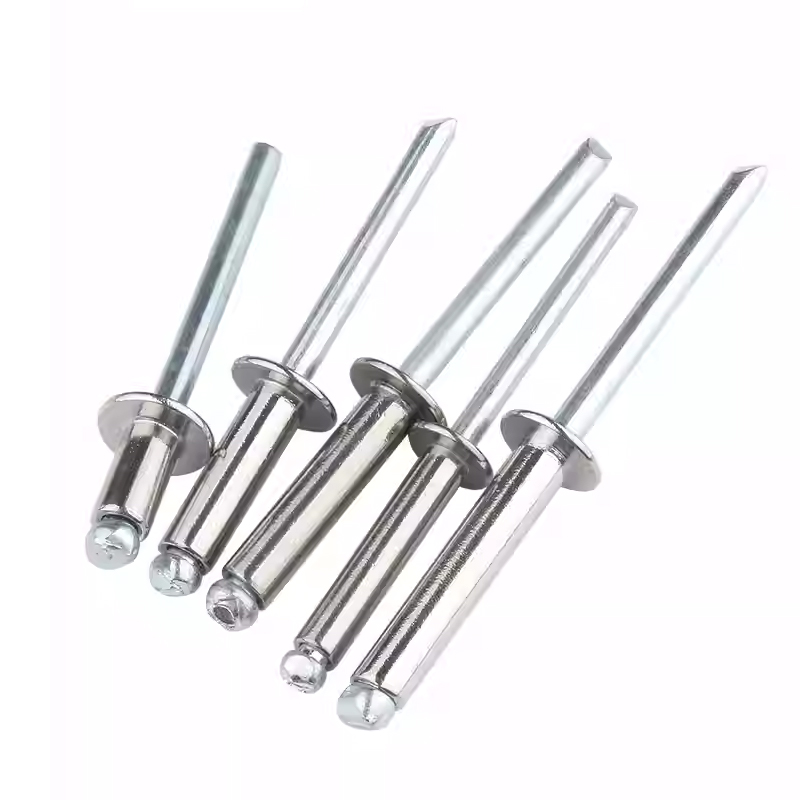
A rivet nut, also called a blind rivet nut or rivnut, is a tubular fastener with an internal machine thread. It is inserted into a round hole from one side, and a tool pulls the mandrel or squeezes the body so that the shank bulges and clamps the sheet between the head and the deformed section — the same working principle as blind rivets, but providing a thread instead of a permanent pin. Installation needs access to one side only, which makes rivet nuts the standard answer for tubes, closed profiles, roll-formed panels and thin-walled castings.
Rivet nuts are available in steel, stainless steel and aluminium, in flat, countersunk and small-flange head styles. First, match materials: an aluminium rivet nut in a steel assembly invites galvanic corrosion, and a plain steel one in a stainless assembly is worse. Second, for thin or soft sheet, a large-flange head spreads the clamp load, and a hex-shank body fitted into a hex hole prevents the installed nut from spinning under later torque. Spin-out is the classic field failure of rivet nuts, and the hex version exists precisely to prevent it.
Load capacity is moderate, lower than a welded nut and generally comparable to or better than a cage nut in the same sheet thickness, and it depends heavily on how thin the sheet is. Where vibration is severe, pair the rivet nut with a locking element on the bolt side, such as the prevailing-torque nut options we compared in a previous article.
Choosing: access, permanence, sequence and volume
Four questions settle the choice in most projects:
- Access. Can the assembly reach both sides? Welding and cage-nut insertion effectively need two sides (or an open profile); a rivet nut needs one. Closed sections almost always mean rivet nuts.
- Permanence. Will the joint be opened and reconfigured? Frequent service favors cage nuts; a thread used for assembly and occasional maintenance suits weld or rivet nuts.
- Assembly sequence. Weld nuts must go in before surface treatment; cage and rivet nuts can be installed after coating, which is a real advantage when parts are painted or zinc-plated at a supplier and assembled in-house.
- Volume and cost. Weld nuts amortize well at high volume with existing welding capacity; cage nuts cost more per hole but need no tooling; rivet nuts need a pulling tool and a few seconds of labor per hole, which scales fine for mid volumes.
Load and vibration then act as a filter: structural or high-vibration joints push toward weld nuts, moderate service loads are fine for rivet nuts, and cage nuts stay in panel-and-rack territory.
It is also worth remembering that captive nuts do not have to be catalog items. Flange diameters, head styles, body lengths for specific grip ranges and hex shanks are routinely produced as non-standard parts — one of the cases where custom fastening hardware genuinely pays for itself, as discussed in our article on standard versus non-standard fasteners.
In practice, a single machine often uses all three families: welded nuts on the chassis, rivet nuts inside roll-formed covers, cage nuts on the service panels. Specifying each deliberately — rather than defaulting to one type everywhere — is what keeps thin-sheet joints strong, serviceable and cost-effective.
NXHD Manufacturing (contact@nxhdmfg.com) is a precision fastener and custom metal parts manufacturer with dual production bases in Handan and Datong, China. We supply standard and non-standard fasteners to OEM customers across Europe, the Americas and Asia.
Key takeaways
- Thin sheet cannot provide enough thread engagement for a bolt; a captive nut supplies the full machine thread instead.
- Weld nuts (DIN 928/929) give the strongest, permanent joint but must be installed before coating and suit stable, higher-volume designs.
- Cage nuts are removable and self-aligning — ideal for service panels and rack equipment, but only for moderate loads.
- Rivet nuts install from one side only, making them the default for tubes and closed profiles; choose material, flange and hex shank carefully to avoid spin-out.
- Real assemblies often combine all three types; match each to access, serviceability, coating sequence and volume rather than defaulting to one.
Frequently asked questions
What is the difference between a weld nut, a cage nut and a rivet nut?
A weld nut is projection-welded permanently into a hole in the sheet, a cage nut snaps into a square hole in a spring-steel cage and can be removed, and a rivet nut is deformed inside a round hole from one side like a blind rivet. All three provide a full machine thread in thin sheet; they differ in installation method, removability and load capacity.
Which captive nut is the strongest?
A projection-welded nut is typically the strongest option because it is fused to the parent sheet rather than clamped to it. Rivet nuts carry moderate loads that depend on sheet thickness, and cage nuts are limited by the spring cage retention, so they are best reserved for panel and enclosure hardware.
Can I install a captive nut with access to only one side of the part?
Yes, a rivet nut is designed for exactly that situation. The tool pulls or squeezes the rivet-nut body so it bulges against the back of the hole, so tubes, closed profiles and roll-formed panels can all receive a full machine thread from one side.
What standards cover weld nuts and cage nuts?
Metric welded hex nuts are covered by DIN 928 (four-projection) and DIN 929 (six-point flange), while cage-nut sizes and hole patterns for 19-inch racks follow the IEC 60297 series. Rivet nuts are less uniformly standardized internationally and are usually specified against manufacturer datasheets, so drawings should state grip range, thread standard and material explicitly.
How do cost, MOQ and lead time compare across captive-nut types?
Weld nuts are usually the cheapest per hole at high volume if welding capacity already exists, cage nuts carry the highest unit cost but need no tooling, and rivet nuts fall in between with a modest tooling investment. For non-standard captive nuts — custom flanges, hex shanks or grip ranges — MOQ and lead time depend on the drawing, so it is best to send the specification with an RFQ.
Does NXHD Manufacturing supply captive nuts and riveting fasteners?
Yes, NXHD supplies riveting fasteners including rivet nuts, as well as standard nuts and non-standard captive-nut variants produced to customer drawings from its dual production bases in Handan and Datong, China. Send your drawing or target specification and we will confirm grades, materials and available options.