 contact@nxhdmfg.com
 +86 352 5330772
 +86 180 3528 0246

Washers are often treated as an afterthought on a bill of materials, yet the wrong choice can loosen a joint, damage the clamped surface, or waste money on a part that adds no value. This guide explains what flat washers, spring washers, and serrated washers actually do, where each one belongs, and when a bolted assembly is better off without one.
What a washer is supposed to do
A washer is a thin plate with a central hole, placed between a bolt head or nut and the clamped part. Its purpose depends on the design, but the main functions are to spread clamping load over a larger area, protect the surface from galling during tightening, act as a bearing surface for rotation, and in some designs resist loosening.
Not every joint needs a washer. In a well-designed assembly with a large enough flange on the bolt head, a smooth clamped surface, and a stable preload, a plain bolt and nut may be the cleanest solution. Adding a washer simply because one is listed in a general hardware kit can increase stack height, reduce grip length, and introduce a new interface where relaxation can occur.
The key is to match the washer type to the failure mode you are trying to prevent. Flat washers address bearing stress and surface damage. Spring and serrated washers address loosening. Mixing them up is a common source of warranty claims and field failures.
Flat washers: load distribution and surface protection
Flat washers are the most common type. They are stamped discs with a hole sized to the bolt shank and an outer diameter that spreads the clamping force over a larger area. The main reasons to specify one are to reduce bearing stress on soft or brittle clamped materials, to prevent the bolt head or nut from scoring the surface during tightening, and to provide a smooth, consistent bearing surface when the clamped part has a rough casting or paint finish.
Material matters. A carbon-steel flat washer on a stainless-steel bolt can set up a galvanic corrosion cell in outdoor or marine service, so the washer material should generally match the fastener material or be chosen for the environment. Hardness also matters: a soft washer can embed into the clamped part under high preload, causing the bolt to lose tension over time. For structural applications, hardened flat washers to EN 14399-6 or ASTM F436 are specified specifically so they do not crush.
When specifying a flat washer, the important dimensions are inside diameter, outside diameter, and thickness. Using a washer that is too thick changes the bolt grip length and can throw off torque-to-preload calculations. For precision assemblies, it is worth treating washers as part of the joint stack-up rather than a generic commodity.
Spring washers: vibration resistance, with caveats
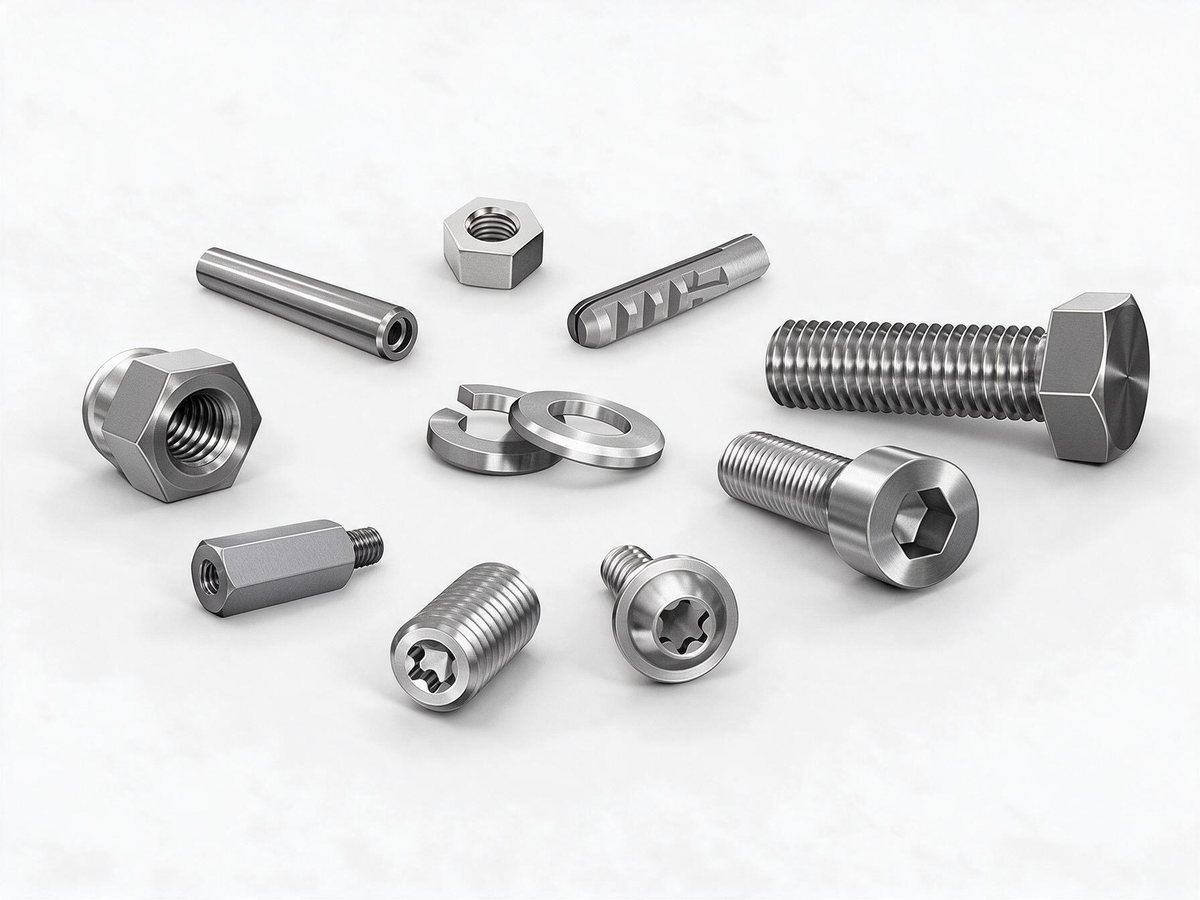
Spring washers — also called split-lock washers — are split rings with a slight helical twist. The idea is that the split digs into the bolt head and bearing surface to increase friction and resist rotation. They are cheap, widely available, and familiar to almost every assembler.
In practice, their effectiveness is limited. Under high clamping loads, a standard split-lock washer tends to flatten completely, at which point it behaves like a flat washer with a stress concentration at the split. The locking action then depends on whether the sharp edges bite into the surfaces, which can damage coatings and painted finishes. Modern vibration testing generally shows that spring washers are less effective against loosening than properly preloaded joints, nylon insert nuts, all-metal lock nuts, or chemical thread-locking compounds.
That does not make them useless. Spring washers can be a reasonable choice for light-duty assemblies where vibration is modest, where joint access prevents the use of a lock nut, or where the washer is being used mainly as a spacer rather than a primary locking feature. They are also common in electrical panels and sheet-metal enclosures where the clamped material is thin and the loads are low.
Serrated and conical washers: locking by geometry
Serrated washers have teeth on the inner or outer diameter that bite into both the bolt head and the clamped surface. The teeth create mechanical interference that resists rotation, even if the bolt preload drops. External-tooth serrated washers work well on large clearance holes because the teeth grip outside the bolt hole. Internal-tooth washers fit in smaller spaces and grip closer to the bolt shank.
Conical washers, sometimes called Belleville washers when designed for spring preload, use a cone shape to maintain a spring-like load on the bolt. They are useful in assemblies that experience thermal expansion and contraction because the washer compensates for small changes in stack height. In high-temperature or cyclically loaded joints, a Belleville washer can help maintain a more consistent preload than a rigid joint alone.
Both serrated and conical washers should be used with care on soft or painted surfaces because the concentrated loads can deform the finish. In corrosion-sensitive applications, the cut surface of a serrated washer can also become a rust initiation point if the coating is damaged.
When to leave the washer out
Omitting a washer is a valid engineering decision. A flange bolt, flange nut, or a bolt with an integral washer head already provides the load-spreading function, so adding a separate flat washer duplicates the feature and adds stack height. In high-strength structural joints, the specification usually defines whether a washer is required, what grade it must be, and whether it goes under the head, the nut, or both.
Washers should also be omitted when they interfere with the intended failure mode. In some tension joints, the designer wants the bolt to stretch predictably within its elastic range. Adding an unexpectedly soft washer into that stack-up changes the spring rate of the joint and can make preload control less accurate. For this reason, many automotive and machinery OEMs list washers explicitly by part number rather than allowing generic substitutions.
Finally, a washer is not a substitute for a correct torque specification, a clean thread, or a suitable locking device. It is one element in a joint system, and it only works if the rest of the system is designed around it.
Specifying washers on a drawing or purchase order
The simplest way to avoid receiving the wrong washer is to call out more than the bolt size. At minimum, include the standard reference, the nominal size, the material and hardness class, and any finish or coating. For flat washers, common standards include DIN 125, DIN 9021, ISO 7089, ISO 7093, and ASME B18.22.1. For spring washers, DIN 127 and ASME B18.21.1 are widely used.
If corrosion resistance is required, state the coating system or the stainless-steel grade rather than writing "zinc plated." For structural applications, match the washer hardness to the bolt grade. A grade 10.9 bolt paired with a commercial soft washer can create a crushing failure mode under the head.
For critical assemblies, treat the washer as a controlled part with its own incoming inspection criteria, just as you would for the bolt and nut. Relevant checks include dimensions, hardness, surface finish, and absence of cracks or burrs that could affect preload. A useful starting point for sampling is described in our guide to incoming fastener inspection.
Key takeaways
- Flat washers spread load and protect surfaces; they do not reliably prevent loosening.
- Spring washers resist light vibration but flatten under high preload and can damage finishes.
- Serrated washers provide mechanical locking through teeth that bite into the clamped surfaces.
- Conical and Belleville washers help maintain preload through thermal cycles and stack-height changes.
- Washers should match the bolt grade and material, and they should be treated as part of the joint design, not a default hardware add-on.
Frequently asked questions
What is the difference between a flat washer and a spring washer?
A flat washer is a plain disc used to spread clamping load and protect the clamped surface. A spring washer is split and twisted, designed to add friction and resist rotation under light vibration, but it flattens under high preload and becomes less effective.
When should I use a serrated washer instead of a spring washer?
Serrated washers are the better choice when the joint faces moderate vibration and you need mechanical resistance to rotation. The teeth bite into the bearing surface, which is more reliable than the friction-only action of a flattened spring washer.
Do washers need to match the bolt grade?
Yes, for high-strength or structural joints. A soft washer under a grade 10.9 or 12.9 bolt can embed or crush, causing preload loss. Use hardened washers to EN 14399-6 or ASTM F436 for structural applications.
What standards cover common flat and spring washers?
Flat washers are covered by DIN 125, DIN 9021, ISO 7089, ISO 7093, and ASME B18.22.1. Spring washers are covered by DIN 127 and ASME B18.21.1. Always include the standard and hardness class on a drawing or purchase order.
Can I use a stainless-steel washer with a zinc-plated bolt?
It is generally not recommended in corrosive environments because dissimilar metals can create a galvanic cell. Match washer material to the fastener material, or specify a compatible coating system for the service environment.
Can NXHD supply standard and special washers to a drawing?
Yes. NXHD Manufacturing supplies standard washers in carbon and stainless steel, as well as non-standard and special-shaped parts produced by stamping, machining, or lean casting to customer drawings. Contact the sales team with your dimensions, quantity, and finish requirements for a quotation.
Source notes: Dimensions and standards referenced are common industry specifications. Always confirm the exact standard revision and material grade required by your project before ordering.
NXHD Manufacturing (contact@nxhdmfg.com) is a precision fastener and custom metal parts manufacturer with dual production bases in Handan and Datong, China. We supply standard and non-standard fasteners to OEM customers across Europe, the Americas and Asia.